“HEPA” is a powerful label, but it is not a complete measure of an appliance. It describes filter media, while real-world usefulness depends on airflow, cabinet sealing, fan speed, room volume, noise and maintenance together. The U.S. Environmental Protection Agency says portable air cleaners are designed to filter a single room or area. They may reduce indoor pollution, but they cannot remove every pollutant and do not replace source control or ventilation with clean outdoor air.
Use the following sequence to evaluate the details that matter in daily use before the more eye-catching features.
1. Start with room volume, not appliance shape
Decide where the unit will run, then measure floor area and consider ceiling height. A 20-square-metre room with a 2.6-metre ceiling contains about 52 cubic metres of air. The same appliance will not turn over the air at the same rate in a low bedroom and a double-height living room.
An “up to” room-size claim is only comparable when you know its assumptions. Look for rated airflow or CADR, the unit of measurement and the fan speed used. If the manufacturer states only floor area, check the ceiling height and air-change assumption behind it.
2. Read CADR together with the particle type
CADR—Clean Air Delivery Rate—expresses the volume of air cleared of a specified particle per unit of time. A higher figure means the unit can reduce that particle faster under the stated test conditions. AHAM certification may show separate ratings for tobacco smoke, dust and pollen; they need not be identical.
Do not compare cubic metres per hour directly with cubic feet per minute. Convert to one unit and compare values for the same particle category. A simple theoretical air-change check is CADR in cubic metres per hour divided by room volume in cubic metres. It is not a promise of performance in your room, but it reveals whether the sizing is plausible.
3. HEPA handles particles; it does not guarantee gas or odour removal
EPA defines HEPA as a pleated mechanical filter that can theoretically remove at least 99.97 percent of 0.3-micrometre particles from the air passing through it. That is a laboratory characteristic of the filter, not an automatic claim about the whole appliance in a room.
Odours and gaseous pollutants are a different task. They require separate media, such as activated carbon; the word “carbon” alone does not disclose the quantity or service life. If cooking odour, solvent vapour or another gas is your main concern, look for precise manufacturer information about the target substance, media load and replacement interval.
4. Do not compromise on ozone
EPA advises avoiding indoor devices that intentionally produce ozone because ozone is a lung irritant. Some electrostatic, ionising, inadequately coated UV or plasma technologies may also emit ozone. “Fresh smell”, “active oxygen” and “ionisation” are therefore not automatic benefits.
If a unit uses electronic air treatment, look for a verifiable emissions certification and the exact model number. The California Air Resources Board maintains a public list of certified air-cleaning devices. Certification does not prove every performance claim, but it provides a separate check for electrical safety and low ozone emissions.
5. Check noise at the speed you can actually use
Maximum airflow often belongs to the loudest setting. If you will run the unit quietly while sleeping or working, the airflow and noise at that usable speed matter more than the maximum headline number.
Look for the test condition and fan speed alongside any decibel figure. “Sleep mode” is not, by itself, a comparable standard. In a showroom, listen for high-pitched motor or air noise as well as general loudness, and check whether the display can be darkened. A powerful machine that is too intrusive to keep running will spend too much time switched off.
6. Filter price and availability are appliance specifications
Add the expected annual cost of particle and gas filters to the purchase price. Check the exact filter code, the manufacturer’s replacement criteria, and whether the part is genuinely available through Hungarian or European retail. An app’s percentage display is often an estimate; follow the manual and consider the actual pollution load.
Also check whether the pre-filter can be cleaned and what happens if the main filter is discontinued. A low-cost machine with expensive or unavailable cartridges can quickly become a worse choice than a dearer model with transparent long-term supply.
7. Placement and airflow matter
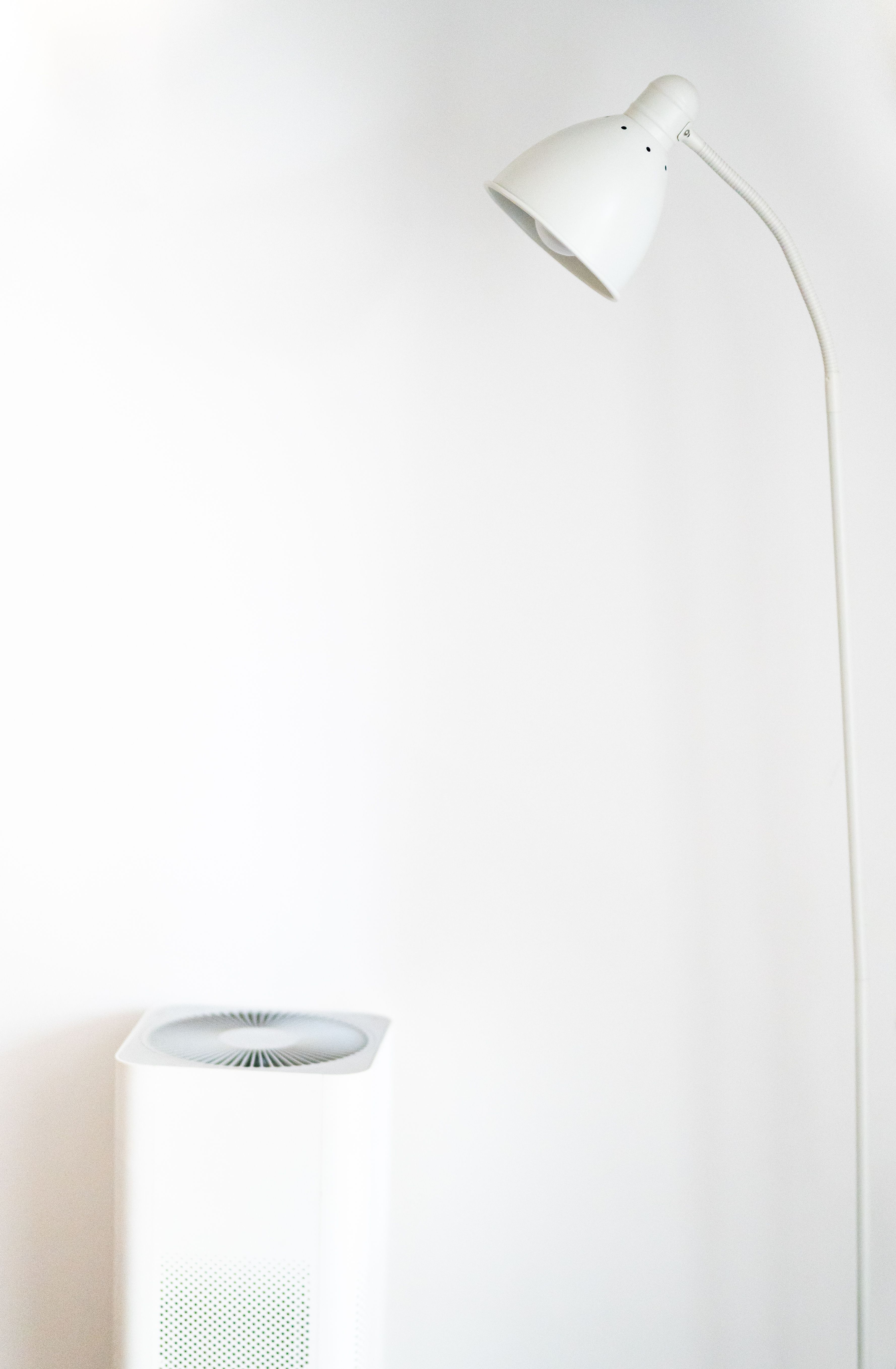
Do not push the intake or outlet against a wall, curtain or furniture. Keep the clearance required by the manufacturer and choose a position where air can circulate. A home connected by open doors is not automatically one large room: walls, doorways and temperature currents can slow mixing.
An air cleaner works while it is running. Longer operation at a lower speed may be more practical than short bursts at maximum speed, but placement and operation should always follow the exact model’s manual.
8. Know what it cannot fix
An air cleaner does not repair a damp wall, remove the cause of mould, exhaust cooking moisture or combustion products, or eliminate the pollution source. EPA specifically notes that a mould problem requires correcting the moisture source and cleaning up the mould; a cleaner may only reduce some airborne particles.
Always act on the source first: suitable extraction, cleaning, no indoor smoking, moisture repair and safe ventilation. A portable air cleaner can complement those measures, not replace them.
Five-minute buying checklist
- Do you know the room’s area, ceiling height and volume?
- Is the exact model’s CADR, unit and fan speed stated?
- Are smoke, dust and pollen ratings listed separately?
- Is your main concern particles or gases/odours, and does the filter match it?
- Does the unit intentionally generate ozone, or is low emission independently checkable?
- Is the noise acceptable at the speed you will actually use?
- Is the exact replacement filter available, and have you calculated annual cost?
- Have you also addressed the pollution source, ventilation and placement?
Choosing a good air cleaner is not about recognising one logo. Room-sized airflow, targeted filtration, usable noise, verifiably low ozone emissions and sustainable filter supply make the appliance practical together.
U.S. EPA — Guide to Air Cleaners in the Home
U.S. EPA — What is a HEPA filter?
California Air Resources Board — Certified air-cleaning devices
Editorially reviewed content