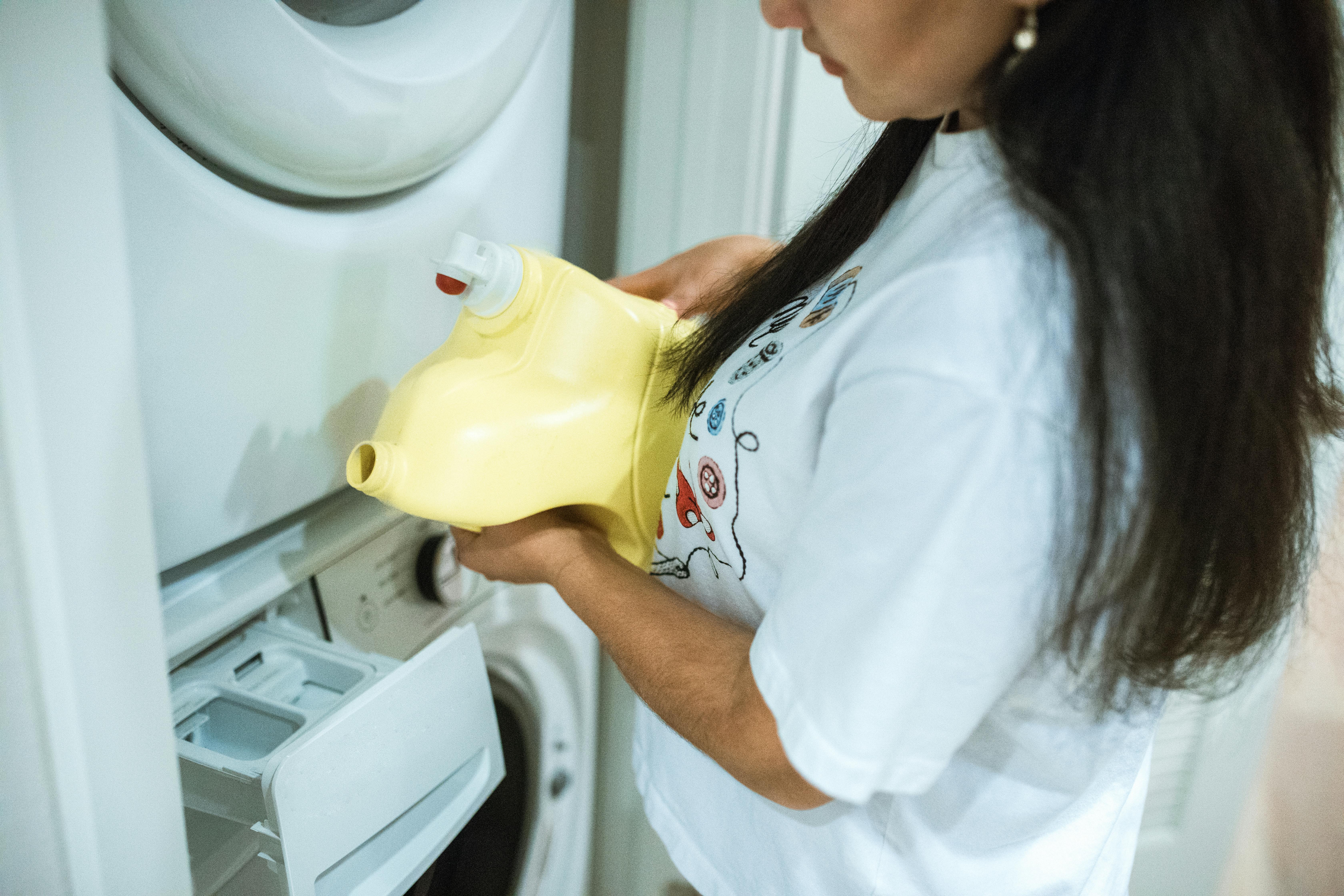
A laboratory review published by Hungary’s National Trade and Consumer Protection Authority (NKFH) on 26 October 2026 compared liquid detergents and washing powders. The laboratory measured surfactant content, checked label claims and dosing information, and assessed whether unopened packaging retained the product. Some form of issue arose in nearly half of the samples examined. One powder contained 94.10 per cent salt and only 0.93 per cent salt-free total surfactant.
That extreme figure is not, by itself, a breach of the law: the authority notes that there is no general statutory maximum for salt or minimum for active ingredients. Proceedings concerned the product’s performance and dosing claims. Nor does the review prove that liquid detergent is always better than powder. The useful lesson is that pack size, price per litre and a prominent promise are not enough on their own.
1. Find the conditions behind the wash count
“40 washes” on the front of a pack is comparable with another product only if you know the load size, level of soiling and water hardness on which it is based. The detailed dosing table matters more than the large number on the front.
If two products promise the same wash count but one calculates it for a smaller load or softer water, they may not deliver the same cost in real use. Check whether the supplied cap or scoop is marked in a way that corresponds to the millilitres or grams stated in the table.

2. Compare cost per wash, not only price per kilogram or litre
A cheaper litre or kilogram does not necessarily mean a cheaper wash. Divide the actual retail price by the number of doses that is realistic for your household. Do not automatically use the maximum wash count on the front; use the dose for your water hardness, normal load and typical level of soiling.
Compare like with like: a normal programme without prewash, a similar load and similar water hardness. This makes a small concentrated bottle and a larger dilute pack meaningfully comparable.
3. Do not leave water hardness out of the calculation
Manufacturers’ tables usually require a larger dose in harder water. If you do not know your local water hardness, check your water supplier’s data and then follow the product’s own instructions. Do not estimate cleaning power from the amount of foam: foam volume is not a reliable measure of performance.
4. Let the fabric and stain decide between liquid and powder
In the NKFH measurements, liquid products generally had a higher surfactant concentration, but that does not make them better for every laundry task. Some powders offer oxygen-based bleaching ingredients, while liquids may be practical for other types of stain and lower-temperature cycles.
Choose according to colour, the garment-care label, washing temperature and the soil you encounter most often. Do not expect one “universal” product to perform identically on every fabric and programme.
5. Check that the promise and composition agree
In the official review, some labels indicated active oxygen even though the laboratory could not detect it above the stated measurement limit. Do not read only the bold message on the front: also check ingredient groups, restrictions and the manufacturer’s dosing instructions.
A claim such as “high efficiency” is not a substitute for comparable information. If a product promises special performance, look for the programme, temperature, stain or dose to which the claim applies.
6. Even an unopened pack should not leak
The NKFH found powder escaping from two packs before they were opened. In the shop, inspect the base, corners and seals of a box and look for signs that an inner bag is damaged. For liquid detergent, check the cap and closure; do not take home a damaged or leaking pack.
At home, keep detergent dry and out of reach of children and pets, always in its original packaging. Never decant it into an unlabelled drinks or food container.
7. More detergent does not automatically mean cleaner laundry
Overdosing does not guarantee a better result, but it does reduce the real wash count, can leave residue on textiles or inside the machine, and wastes money. Follow the product table and the washing-machine manufacturer’s instructions; do not rely on a visual guess of drum volume when a more accurate measure is needed.
For a difficult stain, targeted pretreatment, an appropriate programme or the highest temperature allowed by the care label often matters more than doubling the dose.
OtthonTrend quick checklist
- You have read the load, soil level and water hardness behind the stated wash count.
- You calculated an estimated cost per wash under equivalent conditions.
- You chose the product type for the fabric, colour, stain and programme.
- You checked ingredient groups and restrictions as well as the performance promise.
- The pack is intact and does not scatter powder or leak liquid.
- You set the dose from the label, load and water hardness, not from the amount of foam.
- The product remains in its original labelled packaging in a safe place.
OtthonTrend did not conduct its own product test, does not publish a brand ranking, and this article is not sponsored. Figures and laboratory findings come from the NKFH communication of 26 October 2026 and its official results table.
Editorially reviewed content